Websites designed around your customers
Most business websites lose the visitor at the same point: the person wants to see a price, check availability, place an order or ask a specific question, and the site sends them to a phone number instead. I build the site that answers them on the page, then stays fast and online afterwards.
Who it is for
- Hospitality and property: galleries, availability and direct booking
- Restaurants and food: menu, prices, ordering, delivery and table booking
- Logistics and services: quote requests with the detail needed to price them, plus tracking
- E-commerce storefronts with Nigerian payment gateways and delivery options
- Corporate and product sites that explain a technical product to a non-technical buyer
What you get
- Responsive build, tested on the phones your customers actually use
- Performance and accessibility work, not a lighthouse score bolted on at the end
- Search and AI-search setup: metadata, structured data, sitemap and copy that targets real queries
- A content editor or admin, so you are not paying for every text change
- Launch, DNS and hosting handled, then the fixes that surface once real traffic arrives
Work that proves it
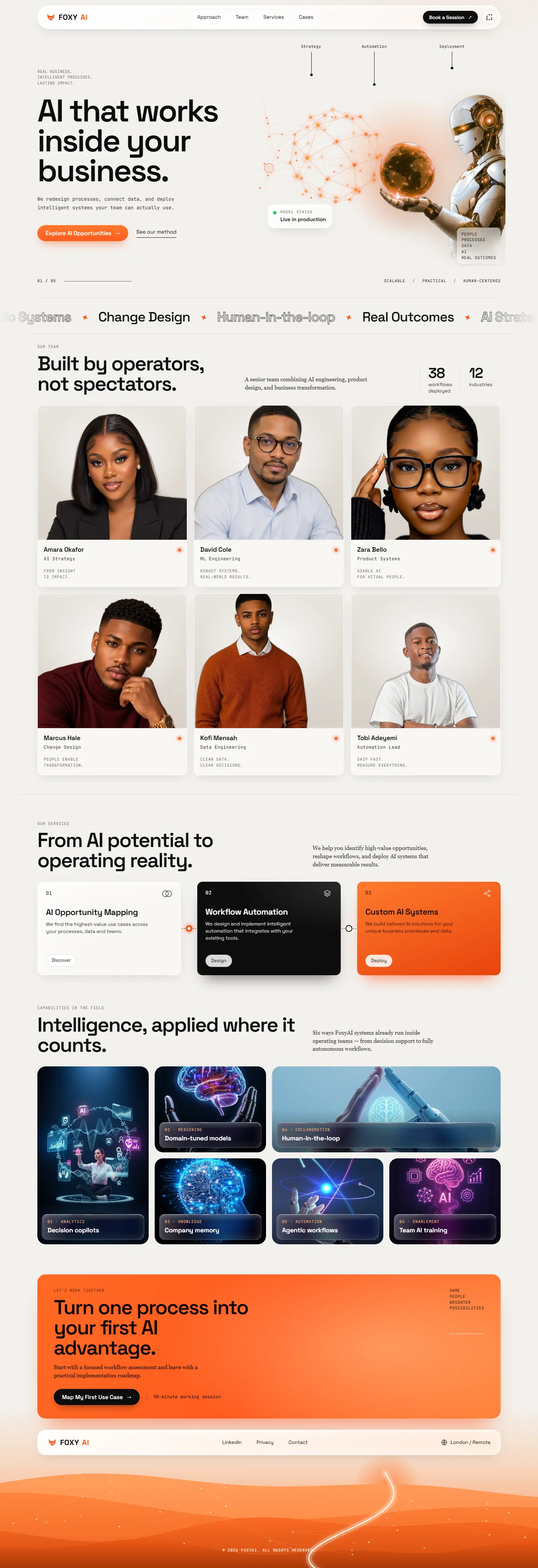
FoxyAI
Most AI consultancies sell a pilot that never reaches production, so the buyer has heard the pitch before and discounts it. FoxyAI is positioned against that: systems deployed inside the business, with processes redesigned and data connected so a team can actually use them. The site sells on operators rather than slideware, with workflows deployed and industries served as figures, the method broken into strategy, automation and deployment, and case work carrying the proof.
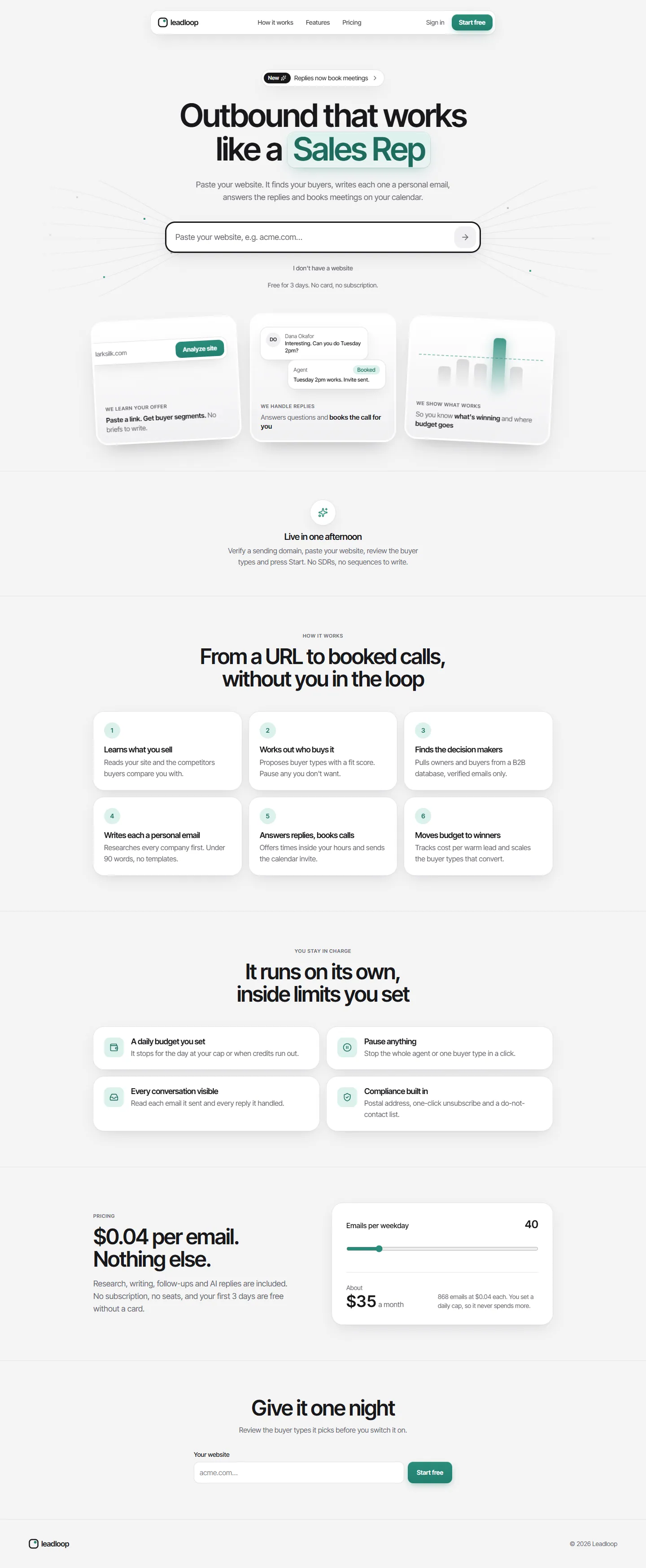
Leadloop
Outbound sales dies in the gap between sending an email and answering the reply, which is where a small team runs out of hours. Leadloop sells an AI agent that closes that gap: paste a website, it works out the buyer segments, writes each prospect a personal email, answers what comes back and puts the meeting on a calendar. The site has to make an autonomous agent feel safe to hand your pipeline to, so it shows a real reply thread being handled, what is working and where budget goes, and a setup measured in one afternoon rather than a quarter.
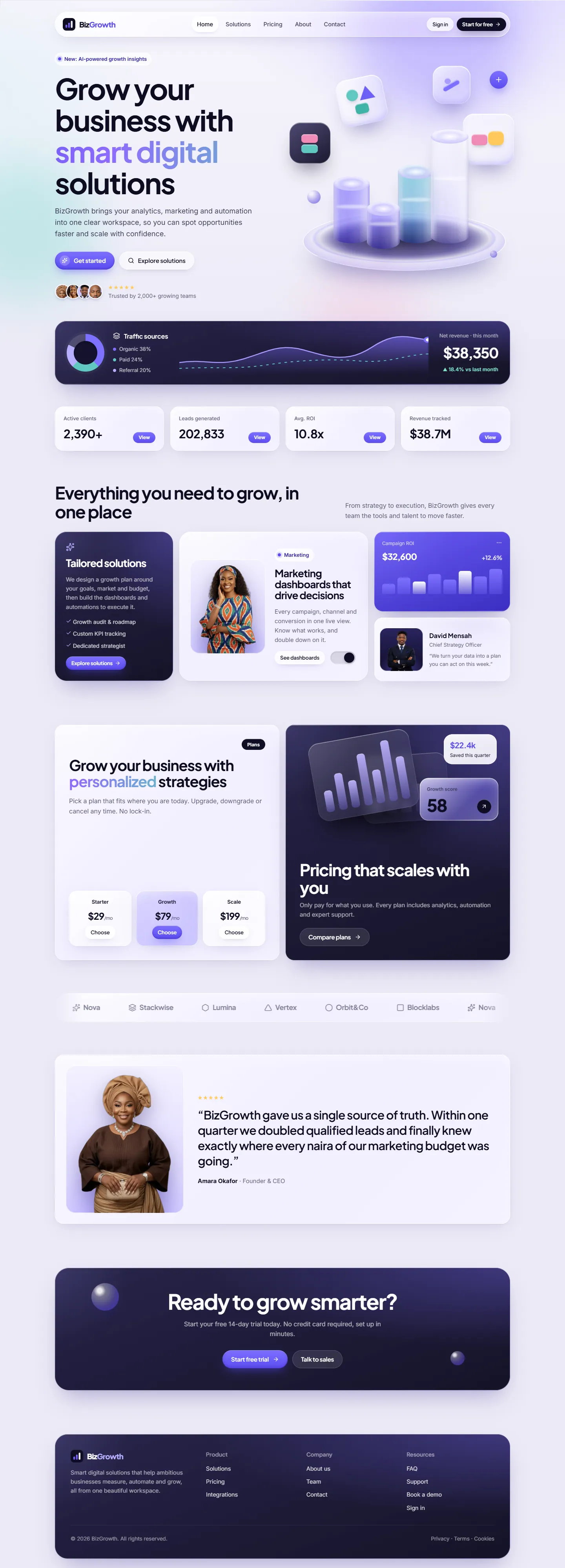
BizGrowth
A growing business ends up with analytics in one tool, campaigns in another and automation nobody owns, so nothing can be compared. BizGrowth is the product site for a workspace that puts them together, and it sells on the dashboard rather than the promise: traffic split by source, revenue tracked month on month, leads and ROI as live figures. Plans are priced on the page, the signup is free to start, and every section drives at the same action.

Abujacars
Buying a used car in Nigeria is a trust problem before it is a price problem: is the car sound, are the papers real, and will the seller still answer next week. Abujacars answers all three on the page. Every car carries a 150-point inspection and customs and papers verification, financing and nationwide delivery are stated up front, and sellers get a cash offer within 24 hours. The fleet is browsable by brand and type with real photography, so a buyer shortlists before anyone picks up a phone.

Foodx
A bakery selling through Instagram posts cannot show a menu, take an order or hold a basket, so every sale costs a conversation. Foodx is the storefront for a Lekki Phase 1 bakery and coffee bar: donuts, cheesecakes, shakes and iced coffee photographed properly, priced in naira, added to a cart and ordered. Location and opening details sit where someone deciding on a walk-in looks, and the menu doubles as the thing search engines can actually read.
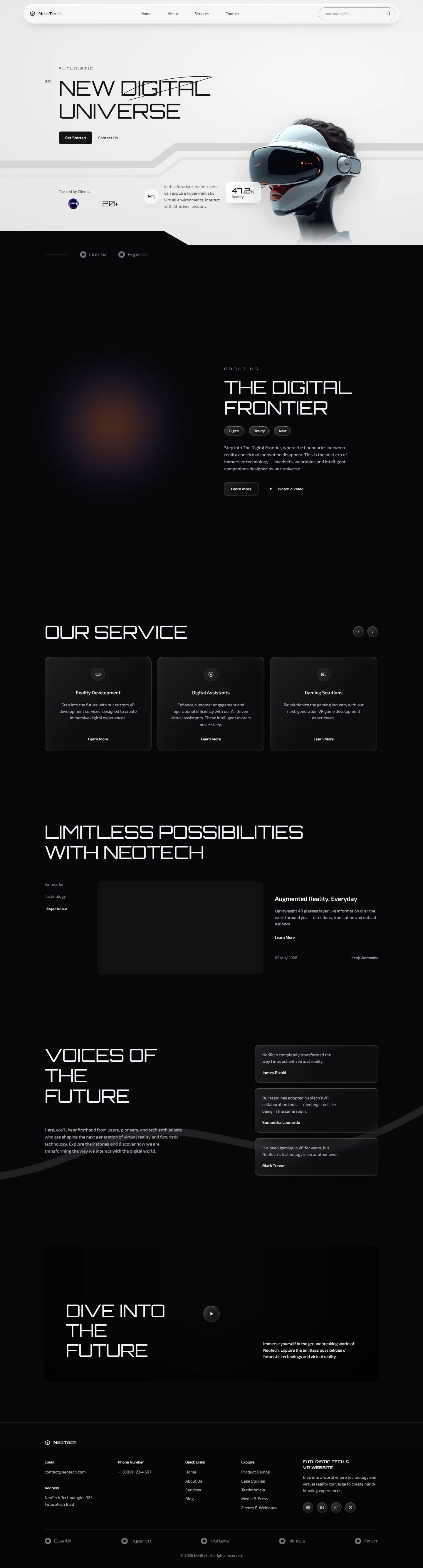
NeoTech
Selling immersive technology on a flat web page is its own problem: describe VR in paragraphs and it sounds like every other agency. NeoTech demonstrates instead, with 3D built in React Three Fiber running in the browser, so the capability is the proof. Around it sit the services a buyer is actually choosing between, VR development, AI avatars and gaming, each written plainly enough for the budget holder rather than the engineer.
Common questions
What kind of websites and apps do you build?
Management systems and the sites around them: point-of-sale and inventory for retail, school management covering enrolment, attendance, results and fees, hospital and clinic sites with appointment booking, freight and logistics sites with quote requests and tracking, restaurant ordering, e-commerce storefronts, and hotel and property booking. If it has a login, a database and money moving through it, it is the kind of thing I build.
Do you build mobile apps as well as websites?
Yes. Mobile in React Native, and the web app behind it in React and Next.js, with one database and one API serving both. Xpel POS runs the counter of a beauty retailer on a phone or tablet and keeps selling when the network drops; SchoolHub is used by school admins on cheap phones over bad connections.
Can you build a custom management system for my business?
That is most of my work. I start from how the business already runs, then build the system around it rather than forcing the business into someone else's software: roles and permissions, the records your staff actually keep, the reports you print, and an audit log of who changed what.
Can you integrate payments and other business tools?
Yes. Depending on your business and location, I can integrate providers such as Stripe, Paystack, Flutterwave and Remita, along with booking tools, email and other APIs. We confirm availability, account requirements and the workflow during discovery so the integration fits the way your business operates.
Have something like this to build?
Tell me what the system has to do and who uses it, and you get a fixed scope, a timeline and a price before anything starts.
Start a project